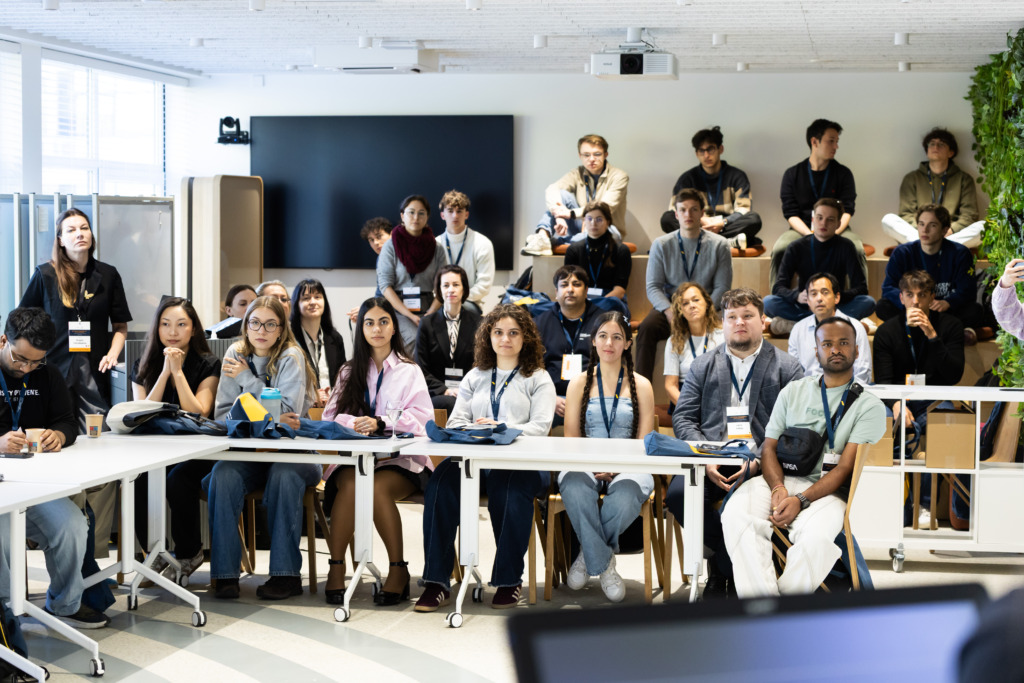



On 28–30 April, the ECIU IGNITE hackathon took place at Kaunas University of Technology, bringing together students and academic staff from different ECIU institutions.
Over the course of three days, participants worked in mixed teams to address challenges related to engagement in ECIU Learning Opportunities (ELOs). The event combined structured activities, teamwork, and hands-on problem-solving, guiding participants from initial challenge exploration to prototyping and final solution presentations.
The energy and impact of the event were best captured by the participants themselves, who left not only with new skills but also with a global perspective. One of the attendees shared their excitement about the journey, noting how the intensive collaboration pushed them beyond their comfort zone: “The hackathon was a transformative experience that allowed me to develop innovative, startup-style solutions while building a lasting international network. It broadened my mindset so much that I’m now eager to dive into every new challenge ECIU has to offer.”
Team Formation and Challenge Exploration
The first day focused on building strong teams and understanding the challenges. Participants were introduced to topics related to incentives, communication, and the role of technology in ECIU Life-long learning ecosystem. They explored issues such as unclear value propositions, fragmented information, and the need for better technology-enhanced human support systems for both students and academic staff.
“Even though the participants from ECIU University were diverse in their fields of study and circles, they demonstrated how well and focused they could work on the challenges, develop initial ideas, work through possible solutions and present well-developed and relevant prototypes“, says Head of the Foreign Language Center Prof. Dr Saulė Petronienė, one of the Hackathon teamcher.
During the working sessions, teams mapped their experiences with ECIU, created “Unengaged Learner/Teacher” personas, and analysed engagement barriers. They defined problem statements and narrowed down the challenges to guide their work in the following stages.
Developing and Testing Solutions
Teams conducted quick research, including SWOT (Strengths, Weaknesses, Opportunities and Threats. SWOT analysis, to better understand their chosen challenges. Based on this, they developed initial solution ideas and created low-fidelity prototypes. These prototypes were then presented to peers and invited experts.
Head of Study Programs of the Faculty of Mathematics and Natural Sciences Dr Benas Gabrielis Urbonavičius, Faculty of Informatics Prof. Dr Daina Gudonienė, Head of ECIU Centre Viktorija Kazlauskienė, ECIU University Activities Specialist Andrė Ališauskienė, Marketing and Communication Lead of ECIU University Sandra Antanavičienė, ECIU University Publicity Coordinator Rūta Mačytė, Business Digital Transformation Research Center Assoc. Professor of Practice Eglė Vaičiukynaitė were on the expert board. The presentations included discussions and Q&A sessions, allowing teams to receive feedback and identify areas for improvement.
“I believe that having mixed groups of students and teachers was especially valuable. They complemented each other well, which is why we ended up with such strong solutions and creative ideas. This kind of collaboration is something we need more of, greater cooperation between students and teachers, sharing perspectives and working together. Not only in formal settings, but through genuine collaboration. That’s when we achieve the best outcomes and results.”, shared Faculty of Social Sciences, Humanities and Art Senior Lecturer Dr Brigita Pantelejeva.
A Structured Three-Day Process
At the same time, another teamcher, Faculty of Social Sciences, Humanities and Arts Lecturer Vilma Sukackė, noted that although there were initial concerns about whether participants from different backgrounds would work well together, the structure of the hackathon ensured smooth cooperation, and teams were able to collaborate without significant communication barriers.
On the final day of the hackathon, teams showcased their solution ideas, explained their approach, and answered questions from a board of experts and other participants.
During the presentations, it became clear how much progress has been made in a short time. As Sukackė highlighted, teams managed to significantly improve their ideas between the initial prototype stage and final presentations, with some solutions evolving into more advanced mock-ups that the participants could try hands-on on the spot.
Overall, the hackathon followed a clear progression – from understanding challenges on the first day, to developing and testing solutions on the second, and presenting outcomes on the third.
Reflecting on the experience, Dr Pantelejeva noted that what started as an overwhelming situation turned into a well-coordinated process, supported by strong teamwork. She emphasised that this type of collaboration – where different participants work together and share perspectives – helped achieve meaningful results within a limited time frame.
As Prof. Petronienė says, prototypes presented for the ECIU community helped all the participants become more invested and engaged in ECIU micromodules and challenges and built a sustainable community for us.
The solutions ranged from streamlined information ecosystems to new human-centric support models that prioritise personal guidance over automated digital tools. The hackathon closed with an awards ceremony, celebrating the shift from seeing ECIU as extra work to seeing it as a co-created journey of lifelong motivation.
Winners and Their Solutions
1st place Team RED. Addressed the challenge “Making technology and information work with human support”. They specified their challenge as “How might we provide support so teaching staff will be willing to engage in ECIU?” They proposed a solution that shows the teachers that ECIU does not add work but rather gives assistance for their activities. The team showcased a mock-up website where teachers have access to a collaborators network, student talent pool, event studio, and impact record. Among the greatest benefits of the proposed solution is that ECIU teachers can connect to other teachers, and, most importantly, see students’ initiatives to organise hackathons or other ECIU ELOs themselves.
2nd place Team PURPLE. Addressed the challenge “Incentives and value propositions”. They proposed the ECIU career bridge that allows a non-engaged student to move from ELOs to internships across Europe. The idea behind their solution is that students would be able to explore the platform, join challenges, validate skills, and move toward interviews and internships. The team’s concept aims to boost participation, strengthen career motivation, and build stronger links between students, universities, industry, and the ECIU network.
3rd place Team BLUE. Addressed the challenge “Making technology and information work with human support”. They proposed a novel instaECIU app for the ECIU University network. The title of the app stands for: I – Inclusive, N – New, S – Sustainable, T – Transparent, A – Autonomous. The app provides help to the student user in terms of organising the application procedure, monitoring its process and progress, planning green travels based on the assigned budget, and has other useful features.